The Pleasure Purpose Matrix
There’s always something new to learn, something important to tackle, and never enough hours in the day. The steady progression of technology brings both opportunity and uncertainty, while personal obligations continually demand attention. No matter how organized or efficient systems become, responsibilities never seem to end. Even as tasks are completed, others remain deferred—often the ones least appealing or most easily postponed. Over time, these lingering duties can quietly sap emotional energy. A key insight is that productivity and time management are only parts of the challenge. A more powerful question emerges: How can one better manage the emotions that arise from ongoing demands? How do people navigate the feelings connected to constant responsibility, in pursuit of both productivity and emotional freedom—even when the to-do list is never truly empty? The mind craves the satisfaction of accomplishment—there’s a real dopamine reward in completing tasks and chasing the next, regardless of its scale. This drive can lead to a cycle of attending to smaller or easier items, while delaying larger undertakings that require more time and focus. Micro-distractions and a continual sense of urgency are almost inevitable, with attention jumping between possible responsibilities and perceived priorities. Ultimately, the important reflection isn’t just “why is this bad?” but rather “what could be done that both advances a goal and brings real satisfaction?” These are the two guiding dimensions for evaluating how to spend time and attention.
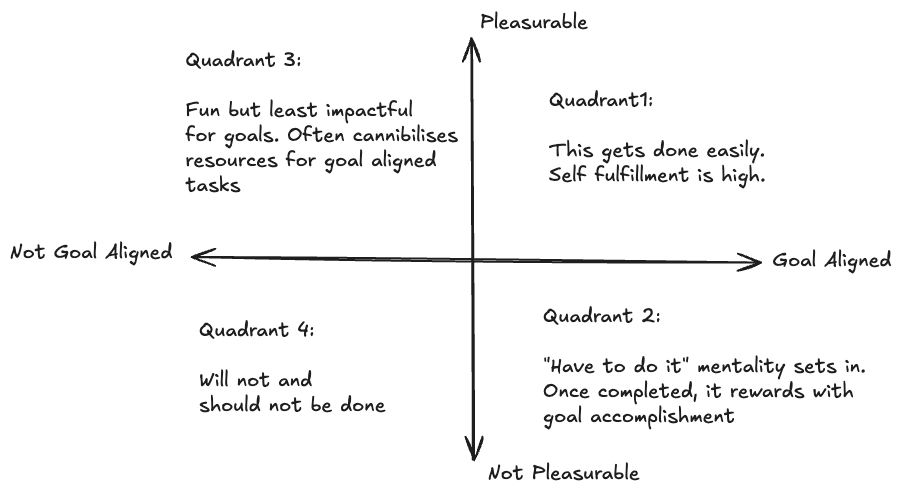
The Four Quadrants of Task Quality
Quadrant 1: Pleasurable + Goal Aligned
The Sweet Spot — Where Progress Feels Natural
This quadrant represents tasks that flow naturally—activities that are both enjoyable and move important goals forward. Motivation comes easily, and these tasks often double as a “reward” for tackling less enjoyable work.
Characteristics:
- They energize instead of draining
- Satisfaction now, progress later
- Symbolize strengths or natural inclinations
- Intrinsic motivation is high
Examples:
- Coding in a preferred language
- Building systems and workflows that drive progress
- Exercising in ways that feel good
- Career-aligned projects that spark passion
Why it matters:
Quadrant 1 is the engine of momentum. Lean into these tasks—they deliver high ROI in productivity and fulfillment.
Quadrant 2: Not Pleasurable + Goal Aligned
The Discipline Zone — Necessary but Not Fun
Tasks here are crucial for progress, but not enjoyable. Skipping them has consequences; completing them yields relief and pride, even if the process is tough.
Characteristics:
- Feel like obligations
- High resistance before starting
- Relief/pride after completion
- Procrastination is common
Examples:
- Paperwork, taxes, forms
- Admin: scheduling, follow-ups, insurance calls
- Tough work: debugging legacy code, performance reviews
- Personal responsibilities supporting long-term goals
Why it matters:
Quadrant 2 is the foundation of achievement. Discipline and grit live here—make these tasks small, structured, and scheduled.
Quadrant 3: Pleasurable + Not Goal Aligned
The Candy Zone — Fun, Engaging, But Dangerous in Excess
These activities bring enjoyment and quick gratification, but don’t drive real progress. Satisfying in moderation, but can easily consume attention if unchecked.
Characteristics:
- Fun, exciting, or soothing
- Instant gratification
- Used to procrastinate tougher tasks
- Can create a sense of false productivity
Examples:
- Browsing tech trends and random articles
- Tinkering/optimizing without real impact
- Non-strategic side-projects
- Social media “research”
- Over-planning, endless editing
Why it matters:
Quadrant 3 isn’t evil—it’s recreational. Allow it in moderation; over-indulgence can erode energy from more meaningful pursuits.
Quadrant 4: Not Pleasurable + Not Goal Aligned
The Drain Zone — Tasks That Should Be Eliminated
Tasks here neither bring joy nor progress. They drain resources and linger out of guilt, habit, or inertia.
Characteristics:
- No enjoyment
- No alignment with personal goals
- Feels pointless to complete
- Linger from guilt or routine
Examples:
- Meaningless administrative busywork
- Over-people-pleasing
- Repetitive tasks that could be automated
- Unnecessary meetings
- Outdated commitments
Why it matters:
Quadrant 4 is the land of ruthless elimination. Cutting, delegating, or automating here unleashes huge cognitive freedom.
How to Use This Model
- Quadrant 1: Do more. Prioritize. Lean in.
- Quadrant 2: Schedule. Break down. Remove friction.
- Quadrant 3: Allow in moderation. Use consciously, not habitually.
- Quadrant 4: Eliminate, delegate, automate, or set boundaries.
This framework creates instant clarity. Use it to assess and organize tasks for a more productive, fulfilling workflow.